
[vc_row][vc_column][vc_column_text]What is Dry Needling?
Dry Needling is a treatment modality that uses very thin needles inserted into tense, tight, or painful muscles. The needles used are so small that 4 of them would fit inside the type of needle that delivers other forms of injections. In the 1940’s scientists discovered that the action of the needle inserted into a muscle or trigger point alone without medication was equally effective with fewer side effects than prior used needling techniques with various medications. Today, many reasons exist to use dry needling as part of a treatment package.
How does dry needling work?
After identifying the area of interest (typically a painful point in a muscle), a thin needle is inserted into that muscle. The action of the needle in the muscle is aimed at reducing the tension of the muscles fibers and thus the pain believed as a result of the tension. For those with muscle spasms, often the needle once inserted will be left alone for 5-20 minutes resulting in a relaxation effect for the muscle. In contrast, a technique called pistoning may be used to stimulate a muscle that is not firing to its max capacity to “wake it up” so to speak.
Who performs dry needling?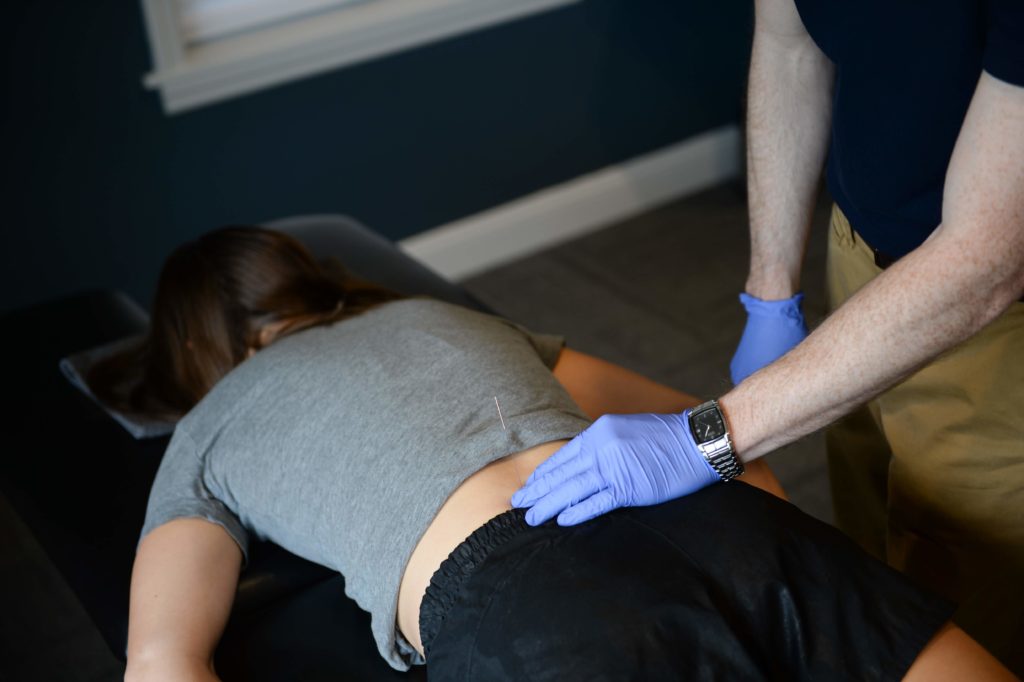
Dry needling is often performed by a physical therapist who has taken the necessary and appropriate post-professional training courses. This is often a series of courses that cover safety, review anatomy, needle insertion technique, patient conditions likely to benefit, side effects, and more
What about dry needling w/ electrical stimulation?
For some individuals electrical stimulation w/ dry needling can be performed. The sensation is very similar to what electrical stimulation otherwise feels like only the sensation goes a little deeper
Are there any side effects of dry needling?
The side effects of dry needling tend to be mild and transient such as bleeding, bruising, local muscle cramping or pain. These effects have been noted in less than 10% of cases.
How fast does dry needling work?
For some they may experience almost immediate reduction in pain or tightness following the treatment. For others the effects may take up to 24 hours.
How many treatments are necessary?
This will be patient and condition specific. Some individuals may achieve benefit in as little as 2-3 sessions while others it may take a few more sessions. Generally dry needling is done in conjunction with other treatments. Some people may choose to integrate dry needling into a maintenance plan every few weeks.
Who might benefit/What is dry needling good for?
There are a vast number of issues or conditions that have been studied and found to benefit from dry needling. What follows is a non-comprehensive list because such a list would be very long…BUT these some of the most common areas or conditions treated and shown to be rather effective: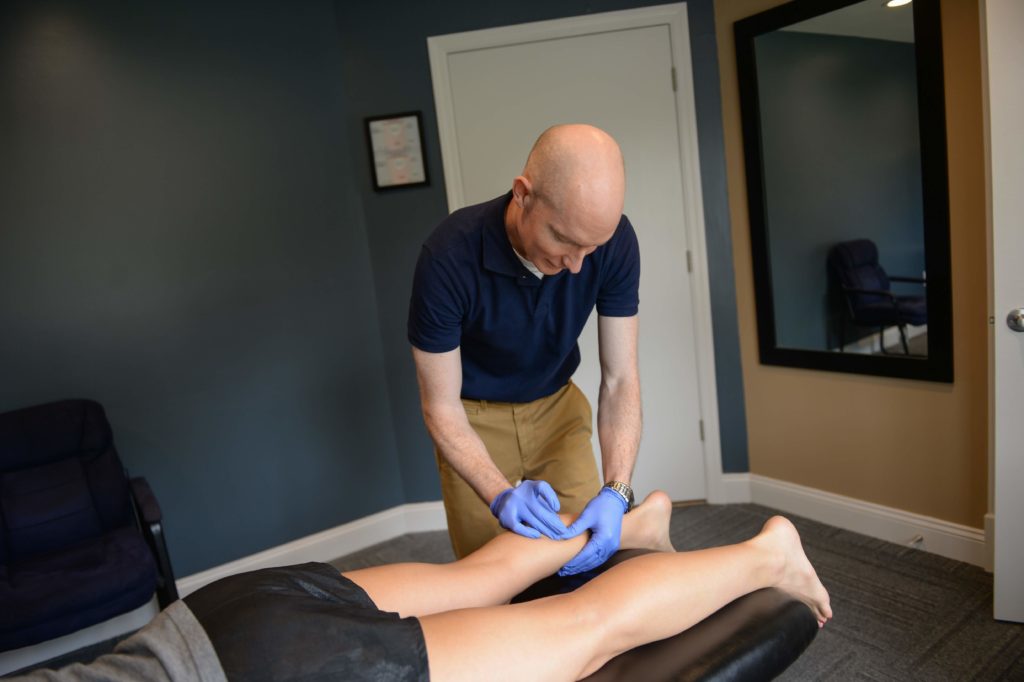
- Plantar Fasciitis
- Tennis Elbow
- Headaches
- Neck or Back Pain
- Muscle strains or sprains
- Shoulder Pain
- Hip or Buttock Pain
- Knee Pain- IT band syndrome, Patello-femoral pain
Does dry needling work/help?
For many conditions it absolutely helps to reduce stiffness, tension, and pain. But don’t just take my word for it…
Let others’ results answer this question[/vc_column_text][/vc_column][/vc_row][vc_row][vc_column width=”1/3″][vc_column_text]Dry needling has been a game changer in dealing with my knee issues. I get a pulling feeling around my knee cap and side of my knee and Andy is able to find sore spots on my quad to treat which has provided tremendous relief when nothing else worked. While the treatment is needles and it can hurt, the result is well worth it and why I keep doing it, especially knowing the long term gains are worth it. The dry needling relieves sore spots and allows the muscles to relax. The results last longer than massage for me.
Andy has been dry needling my quads for years to help manage knee arthritis and now recently for complications in my knee replacement recovery. He has used dry needling with electrical stimulation also which feels like a deeper, more intense tens unit stimulation. It relaxed my muscles enough to finally make progress in range of motion gains.
Andy has used dry needling on other muscles/body parts too (calf, hamstring, biceps, jaw/TMJ muscle spasm). Each feels different. Some locations I really didn’t feel any discomfort but did feel relief later. The quads are the most intense for me but again it’s just a few minutes. He also used a scar technique on my knee replacement incision. After several treatments, the top of my scar at the quad is smooth, no longer puckered, and relaxed the quad muscle.
A side benefit to dry needling is that I am more aware of the muscle sore spots and their relation to aches and pains I’m experiencing. Between dry needling sessions, I can use a roller stick or massage to target the appropriate areas. I can also communicate my issues better by being able to distinguish sore sports vs overall aches. – Deb M[/vc_column_text][/vc_column][vc_column width=”1/3″][vc_column_text]I’ve dealt with neck pain and headaches for years off and on. Typically I would try self massage, stretching my neck, and took plenty of medication to attempt to resolve the pain. Some days it worked but many it did not. I worked with many providers over the years and did get some relief, but the issues remained. One day I read about the potential benefits of dry needling. After searching I found the name of a person who did it.
After talking with Andrew, he said he felt like the dry needling might help along with other treatments. That first day my headache was an 8 or 9. After he did some hands-on treatment, he did the dry needling. When I got off the table my headache was gone. He told me it would likely provide relief for some time but wasn’t sure how long it would last and that I would have to do my exercises. I was surprised that the benefit lasted 3 or 4 days. Within a few more sessions my headaches were under control and my neck pain was but a fraction of what it was. The response to the dry needling was amazing. – Erin S[/vc_column_text][/vc_column][vc_column width=”1/3″][vc_column_text]Several years ago I broke my elbow falling off a ladder. After surgery I went through weeks of rehab trying to get my range of motion back. Despite effort I have had to work for years without full motion in my elbow. As a result, I deal with pain in my elbow most days at work. I heard about dry needling and decided to give it a try. Amazingly it helped to reduce my elbow pain dramatically, almost eliminating it. Now I am not 100% pain-free but it is close enough that my arm no longer bothers me at work every day. So glad I tried the dry needling; some much so that I have gone back to have other injuries and aches treated the same way. It works great. – Sam P[/vc_column_text][/vc_column][/vc_row][vc_row][vc_column][vc_column_text]
Curious if this intervention may be helpful in your condition?
If so, then click the Telephone Consult Button above to request a call to discuss its benefits
[/vc_column_text][/vc_column][/vc_row]